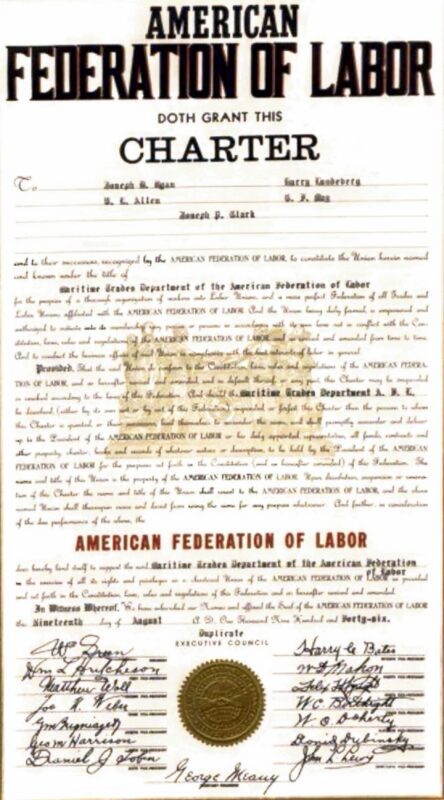
Eighty years ago today – August 19, 1946 – in the city of Chicago, AFL President William Green and Secretary-Treasurer George Meany, joined by the federation’s 13 vice presidents, put their signatures to the charter creating the Maritime Trades Department.
Joseph P. Ryan of the Longshoremen (ILA); Harry Lundeberg of the Seafarers (SIU); W. L. Allen of the Commercial Telegraphers Union (now part of the Communications Workers of America); Charles F. Mays of the Masters, Mates & Pilots (MM&P); and Joseph P. Clark of the Brotherhood of Firemen and Oilers (now part of the Service Employees International Union) received the founding document constituting a coalition to provide unified action and mutual aid for workers on the ships, the docks and the ports.
At the MTD’s first convention in October 1946, John Owens of the ILA served as executive secretary. The preamble adopted by the body read: “We, as workers in the transportation industry, realizing the necessity of strong, unified action in our endeavor to raise our social and economic standards to coordinate our efforts in our struggle for our rights… in the ships, the docks and shoreside workers – will be organized under the American Federation of Labor, hereby dedicate ourselves to mutual aid, support and to direct our action through the medium of the Maritime Trades Department of the AFL.”
In 1947, the department adopted a policy of chartering Port Maritime Councils (PMC), which over time became the grassroots backbone of the MTD. The first councils were established in Milwaukee; Cleveland; New Orleans; Duluth, MN; Ashland, WI; and Washington State (Columbia River). By 1948, new PMCs had started in New York City, Chicago, Detroit, Puerto Rico and Savannah, GA.
What began as a handful of unions in a Chicago meeting hall has grown into a grassroots force of Port Maritime Councils reaching across the United States and Canada. Eighty years on, mariners and allied trades workers still stand shoulder to shoulder, demanding that every job along the water include the dignity, respect, and safety that every workplace deserves.
Today, as we face a historic Jones Act waiver and a rising tide of foreign vessels along our own coastlines, the MTD’s mission to preserve the American maritime industry—and the good-paying union jobs that come with it—is as vital as ever. Thank you to all the mariners, allied trades workers, industry leaders, staff and union officials who have carried these past eighty years of solidarity forward and made the MTD as strong as it is today.